Block.one · 2019
Voice Social Platform
Blockchain-Powered Social Network

- Duration
- 13 months (2-week sprints, monthly releases)
- Role
- Lead Product Designer — Front-End Architecture
- Team
- 7 Product Designers, 5 Front-End Engineers, 12 Blockchain C++ Engineers
- Tags
- Product Design, Blockchain, Social Media, EOSIO, UX Research
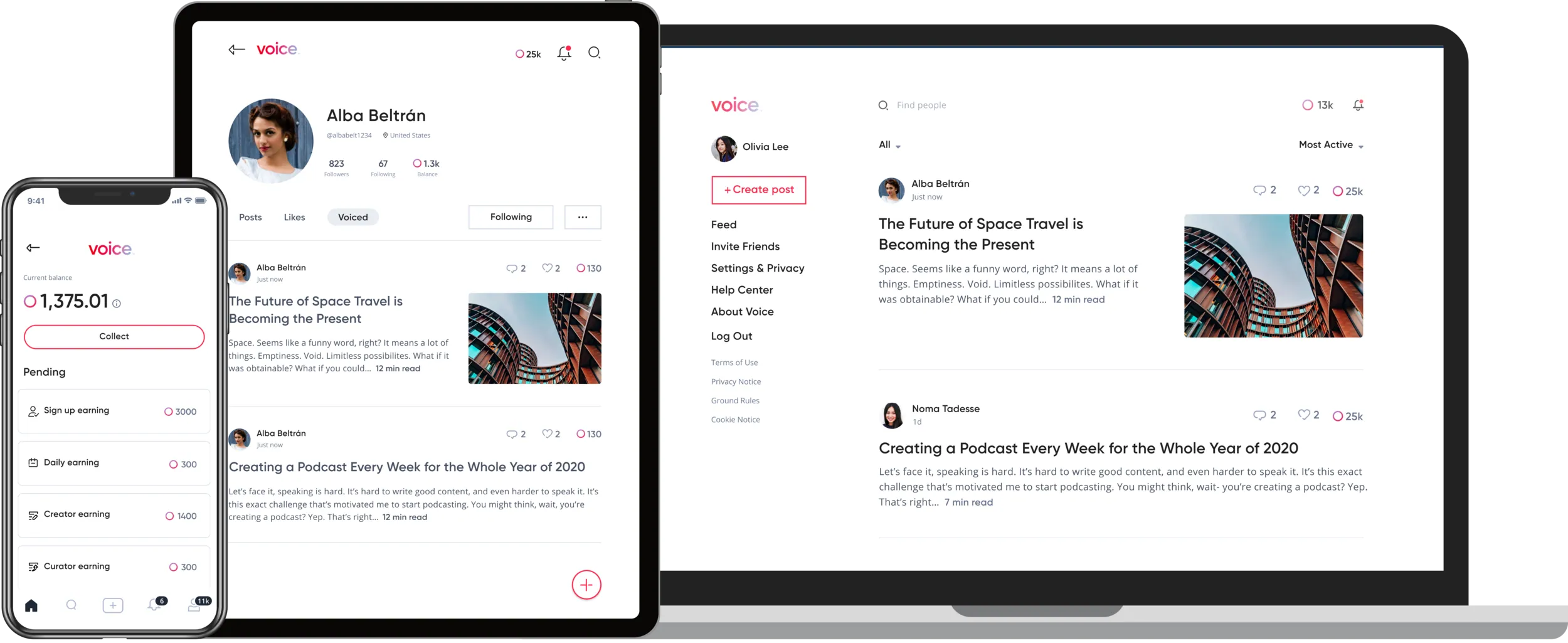
Designed a social app on the EOSIO blockchain with real identity, transparent algorithms, and creator rewards. Led product design across native iOS, Android, and responsive web. The React app launched February 14, 2020, followed by iOS on July 4, 2020 and Android on July 15, 2020.
Overview
Design a social app built on the EOSIO blockchain by providing users with a platform where their voices truly matter.

Goals
Create a transparent and trustworthy social network where content creators are rewarded for their contributions. Through the use of blockchain technology, ensure that user-generated content is secure and free from manipulation.
My Role
I came in early as the President was working on the overall architecture and was in Hong Kong during the first month kick-off. My goal was to define the architecture needed on the front-end.
The product layout direction was informed by conducting UX interviews with day traders who came from the banking industry. From that we could start to visualize an ideal trading flow and make priority decisions.
Tools
Sketch, Abstract, Figma, ProtoPie, Principle, InVision, Rotato, Cards, Sticky Notes, Whiteboards, Whimsical
The Problem
Social media is starting to evolve, spurred by the need for change in several key areas.
Fake Users
Many platforms have become accidental conduits for questionable content as bot farms have become easier to scale. What people are calling for is a way to ensure users on the platform are real humans.
User Data
A major issue is a perceived lack of clarity around how platforms handle and share their users' data when interacting with third parties. Users are increasingly concerned about their data and their privacy.
Non-Transparent Algorithms
How information is populated in content feeds and across the internet is a hot topic. The ability to understand how content is shared is powerful, and there is demand for a more open, user-controlled solution.
Outcome
We launched the responsive React app on February 14, 2020, followed by the iOS app on July 4, 2020 and Android on July 15, 2020. Growth is steady under an invite only model as we continue to roll out to more countries.